Learn
Build understanding. Ask questions. Develop knowledge and skills before deciding what to delegate.
A practical framework for secondary education
Helping secondary students learn, use, and create with AI without outsourcing their thinking.
The important question is no longer whether students use AI, but whether their use preserves and develops their capacity to think.
AI changes what students can produce.
Great teaching changes what students are asked to think.
Start here
Designed for secondary-school learners, the Learning Intelligence Framework (LIF) helps students learn, use, innovate, and develop insight while building AI literacy, creativity, responsibility, and sound judgment.
Students learn to question information, verify results, document their process, revise their work, and remain responsible for what they create.
Developed in an Ontario secondary-school classroom, the framework is designed to be useful to educators wherever they teach.
Students still need fundamental knowledge of the subjects they are studying. They also need to understand what AI means within the context of each subject. LIF helps students decide when to use AI, when not to use it, and how to remain responsible for their thinking, choices, and learning.
Download the one-page LIF overviewBuild understanding. Ask questions. Develop knowledge and skills before deciding what to delegate.
Apply tools with purpose. Verify, evaluate, and make responsible choices.
Create new ideas. Solve problems. Make an impact.
Reflect on decisions. Name the learning. Carry understanding forward.
Temporary support. Lasting capability. Students move from guided support toward increasingly independent judgment, skill, and creative ownership. Cognitive ownership means students can explain, question, adapt, and defend the thinking behind their work—even when AI helped them produce it.
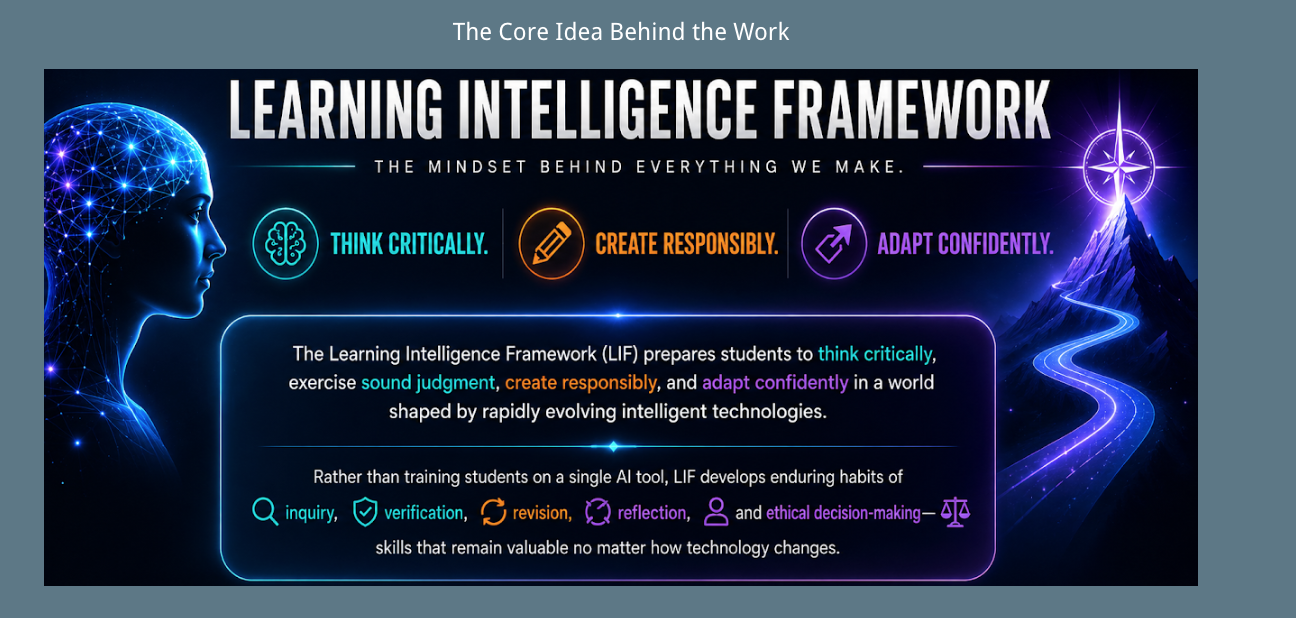
The core idea behind the work
LIF develops durable habits: inquiry, verification, revision, reflection, and ethical decision-making that remain useful as technologies change.
This requires more than AI fluency. Students need AI intuition: the ability to use it, verify it, judge it, and know when their own knowledge, observation, and judgment must lead.
Video introduction
A short introduction to the Learning Intelligence Framework, and why student thinking, judgment, and process matter in the age of AI.
Watch on YouTubeExplore the three modulesLearn · Use · Innovate · Insight
A simple framework. A powerful mindset.
How we use intelligent tools without outsourcing thinking.
The goal: Technology moves fast, but human judgment comes first. Students learn to use AI as a coach, not a crutch.
“If the AI does the pushups, you don’t get the muscles.”
How we should think about AI.
The goal: Shift the question from “How do I use AI?” to “How should I work with AI?” so students remain in control, aware, and creative, not passive passengers.
Signature learning experience
The golden rule: the job is not to find a quick answer; it is to become a better thinker. Gemini is used as a discussion partner that debates, challenges, and tests ideas, not as an answer machine.
Students identify their panel and respond in 3–5 sentences to one prompt:
Assessment: individual depth of thinking, not agreement with a predetermined answer.
“AI helps you create. You decide what matters.”
How we work with AI without surrendering voice, judgment, or authorship.
The goal: Master multi-tool workflows and use metacognition (thinking about your thinking) to direct high-level AI media productions without losing creative voice.
“Don’t start with a simple prompt. Start with your goal, and make the AI ask better questions.”
Classroom practice · See the evidence
See how assignments, Design & Skills Documents, Trust Audits, and student reflection make creative decisions and learning visible.
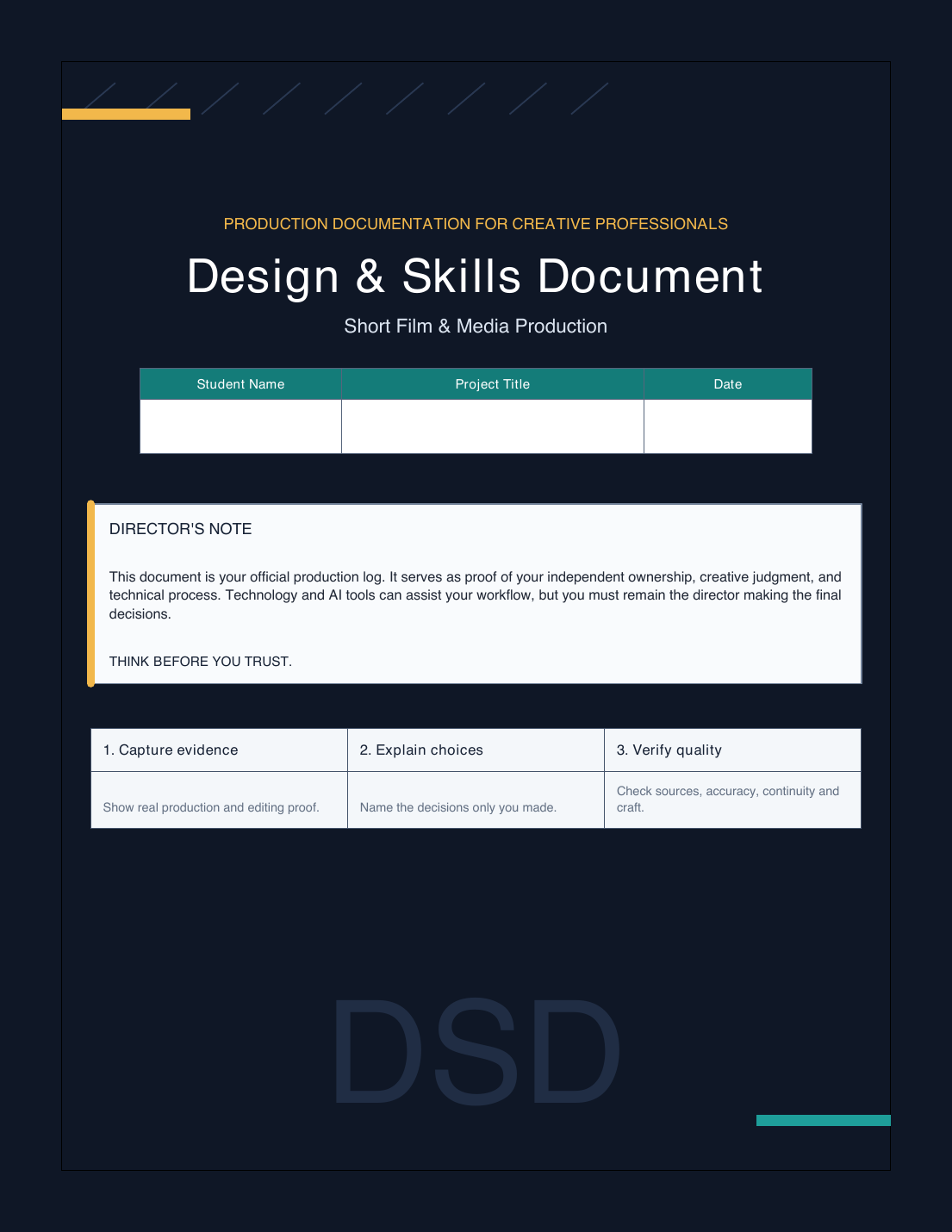 Production-ready D.S.D.Assets, AI delegation, verification, and reflection
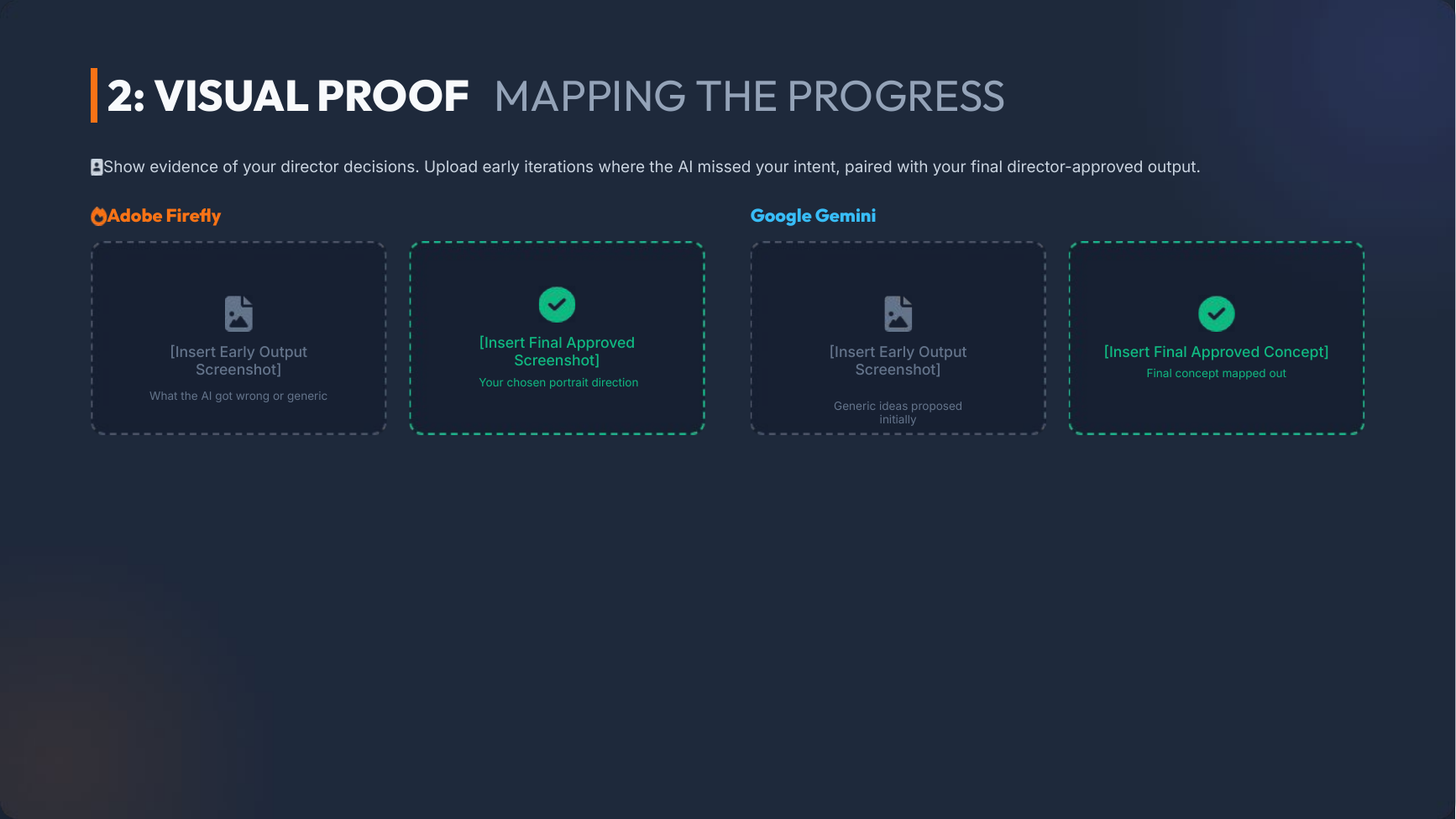 D.S.D. LitePrompts, revisions, visual proof, and integrity
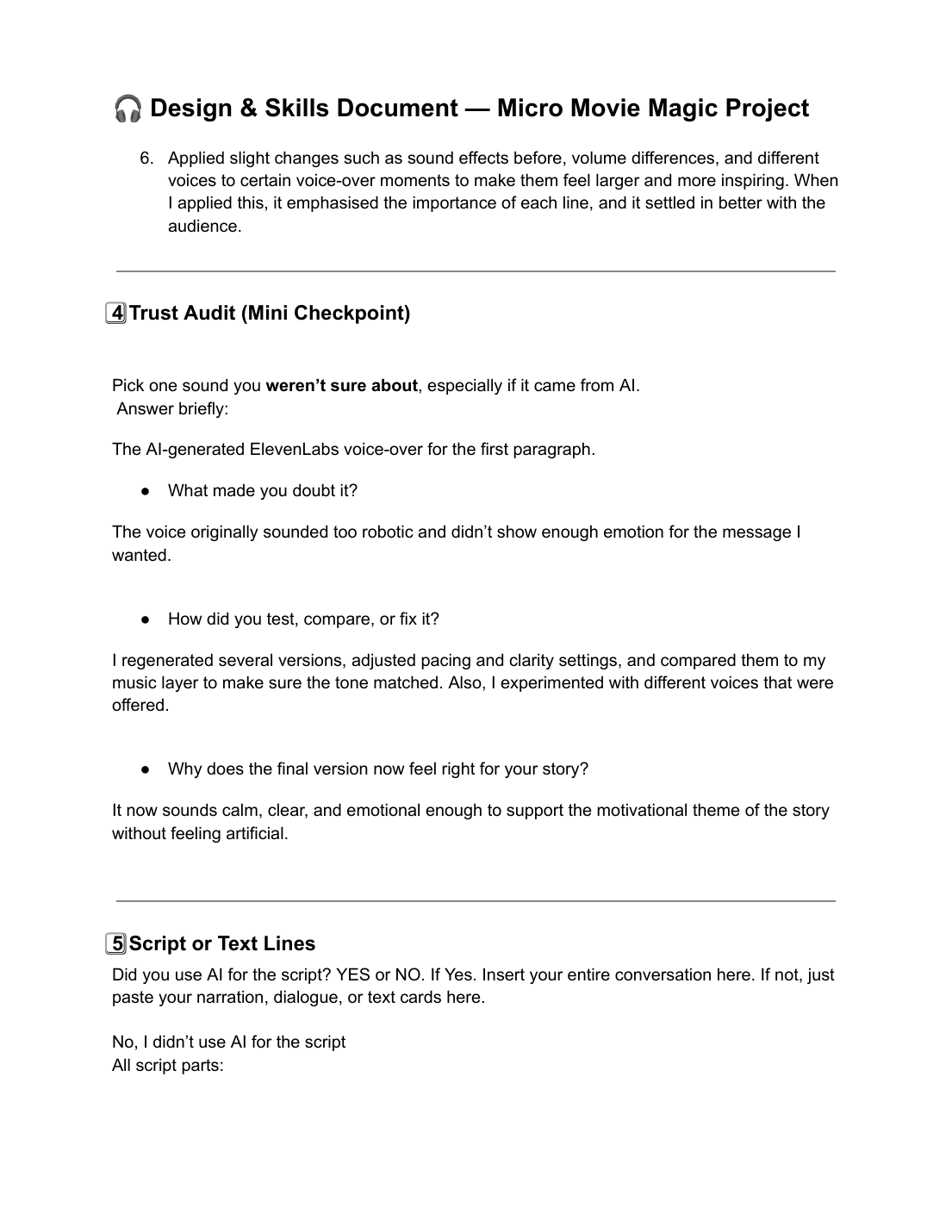 Authentic student evidenceEditing choices, Trust Audit, and reflection
Looking for academic-integrity guidance? Explore the Teacher Guide →
AI is increasingly able not only to produce polished work, but to perform parts of the thinking process itself: exploring possibilities, building models, planning steps, and solving problems. Teachers therefore need stronger ways to ensure students continue developing knowledge, judgment, understanding, and the ability to explain and defend their decisions.
The goal is not AI-proof assessment. The goal is learning-rich assessment.
For me, this work began with a personal question about my own children and my students: What will they need to do, and who will they need to become, in a world shaped by AI? Since 2022, that question has led me to experiment with ways of helping students think more, not less, with this technology.
Sources & context
Explore selected research, books, institutional guidance, and professional learning that have informed this framework.
View all Sources & EvidenceResearch, education, and outreach supporting responsible AI literacy.
HarvardResearch-based frameworks that deepen thinking, learning, and understanding.
StanfordClassroom-ready AI literacy resources co-designed with secondary-school teachers.
These links provide relevant context; they do not imply endorsement of the Learning Intelligence Framework.